In order to make the most of this page, please identify the number and letter that best describe your knowledge of genealogy along with the situation in your ward or branch.
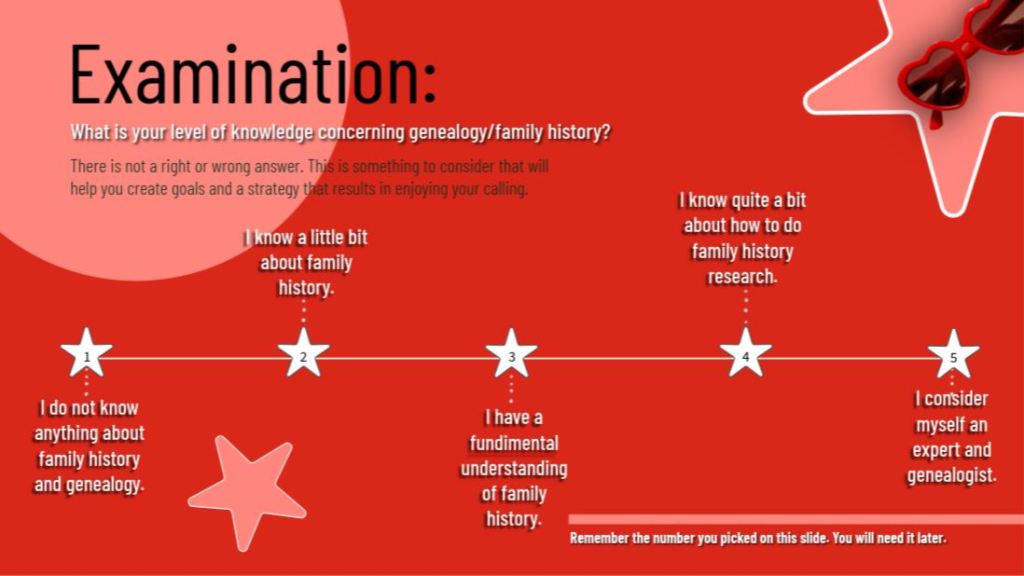
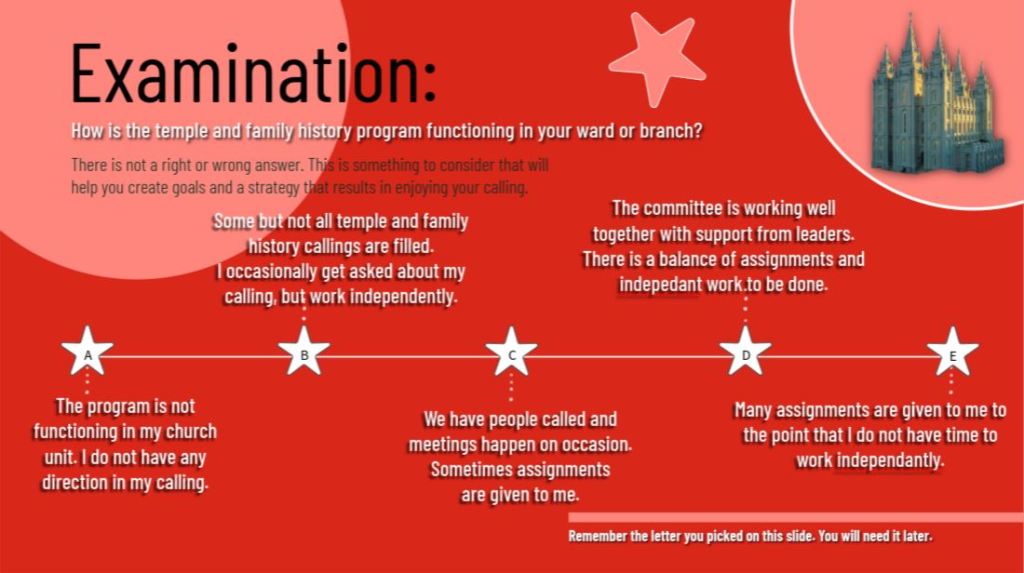
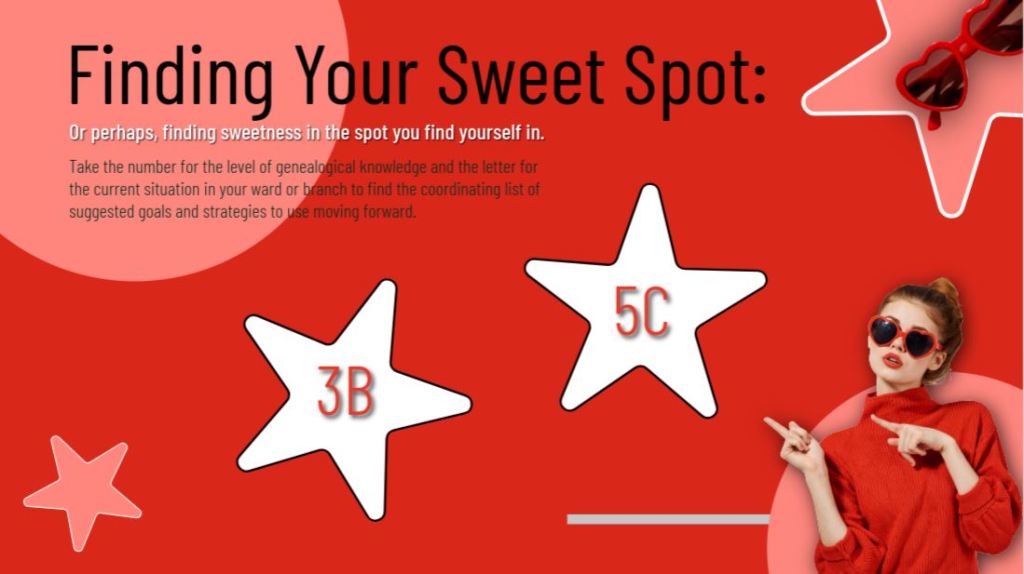
Use the number and letter combination to identify ideas on the following chart to help you make the most of your family history consultant calling.
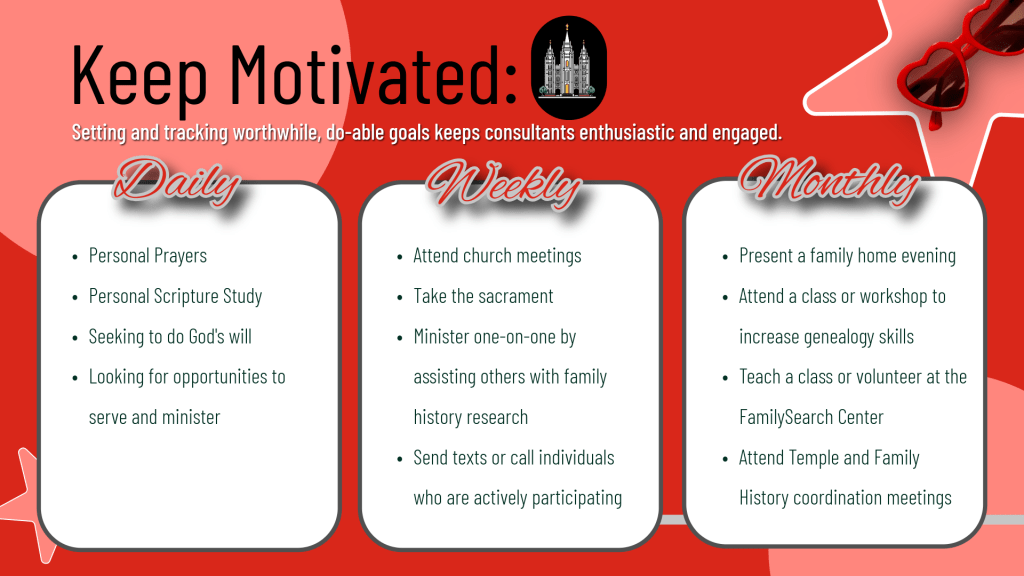
The following are additional ideas for activities tied to genealogy that may help family history consultants make the most of this gem of a calling:
ACTIVITY IDEAS FOR FAMILY HISTORY CONSULTANTS:
- Billboard’s Top Hits: What songs were popular when your parents, grandparents, etc. were young? This could be done as a “Decade’s Dance” with a couple of songs per decade, demonstrations of line dances and special appearances of performers from some of the decades. Focusing on just 3 decades per activity could mean this could be ongoing, once every quarter or over a few months. People could come in costume to make it more fun and there could be costume awards.
- Christmas in July: Craft classes that take information from family history research and turn it into gifts and home décor items. This would be like old-school homemaking night with a family history twist. Of course, serve holiday-type refreshments (maybe having sisters volunteer to bring something they made with a family recipe or something that represents a family tradition).
- Christmas Workshop: Crafted gifts kids can make using family history information.
- Creative Journaling: A presentation of creative ways to make the record of your life. Some ideas might be; Journal in a jar, photo essays, different ways to document how kids grow, fun ways to share and display important dates, gratitude journal, books I’ve read journal (or take any talent you have and make a journal with it… piano songs I learned, photos of dinners I cooked, flowers I grew, quilts I made, etc.), ways to record and display places you have been and how to share whatever journal you choose with future generations.
- Daddy/Daughter or Mother/Son: Have children bring a parent to an activity that helps them work together (team games or making something together) and then have is structured so that they get to talk together and fill out something that helps the child learn things about the parent’s life that they may never have known before. The parent should also learn some things about the child. Have it in a format (written or recorded) that can be saved and added to family history records.
- Day of the Dead Challenge: Hold this activity to get everyone excited about finding a family name to take to the temple. Train them on how to do that (you may consider using the My Family Booklet) and then challenge them to find a name to take to the temple to be baptized for before Halloween. Offer specific times they can get help and people who will assist them. Make it some sort of challenge with a reward that ties into the theme and encourages them to finish before Halloween. Make a book or bulletin board to track progress and share experiences or stories they find. Include pictures of them taking their names to the temple to encourage others. Baptisteries are not usually busy on Halloween so if your group is small, reserve it for that afternoon and take all the names together.
- Primary Activities the Family History Way: Presentation on how to complete goals and projects with family history focused ideas.
- Fabulous Family Blogs, Posts and Newsletters: Creative ideas for sharing what’s happening with your family. Mini classes could be online tools, basic design principles, organizing your writing, basic photography techniques, Christmas cards with a kick, whatever talented people in your area can teach that would fit into the topic.
- Family Game Night: Families come and work together as a team to play giant game boards or competitive games that are funny or extreme. Explain the importance of families playing together and teach about how a family is like a team, helping each other through life and working so they all succeed together. Encourage them to use the center to see if they can learn more about their family because even those who have passed on are still on our family team and families are forever. Encourage them to invite another family to join them to do the activity next month with a two-family team.
- Family Game Night Extreme: The same as family game night but this time they invite another family from the community to come with them. Be sure to make a presentation about how important it is for families to play together and that families can be together forever. Explain that the center can help them learn more about their family and where they came from. Encourage them to explore the center and look up something about their family before they leave.
- Family Recipe Challenge: Each family brings samples of their favorite family recipe to share. They also get to share or display the story of why that recipe is special to their family. Have fun award certificates for different categories that celebrate taste, how old the recipe is, how far the recipe came from, etc. You could figure out a good way to share the recipes via cards people pick up as they sample, a recipe book, or just emailing the recipes.
- Fingerprinting: This is a safety night and a great activity for people to invite other families to attend with them. Use a detective theme and maybe have a mystery going on (with people in costume giving out clues). Help everyone make a fingerprint card and fill it out with identity information. They can keep these for their family history record but it is also a good thing to have for the safety of family members in case someone is ever lost. At some point, have the mystery solved and then get an engaging person to explain that we are all detectives trying to find the right people to fit on our family tree. Invite them to use the center to investigate where they came from and who their ancestors are. Some police departments have supplies for the identification cards and will even volunteer an officer to do the fingerprinting. It’s part of a keeping kid’s safe program. Otherwise, it’s easy to make a simple card and get a couple of ink pads from the craft store. Be clear you are not keeping any of this information.
- Food Traditions: Making them, sharing them and discovering them from your past.
- Friends and Family Night: This is a missionary activity where each person should bring a friend or neighbor. Start with an engaging speaker or two who share neat experiences from their family history and then use the My Family Booklet and the resources of the center to help everyone get started on their family history. You may want to plan a follow up to this activity so the same group can come back and share what they found. Also, having committed to report on their findings makes it more likely they will follow through with the research. Members and their friends should work together on both of their booklets so they are strengthening friends and family. This is a great thing to bring neighbors, co-workers, acquaintances or less-active members people visit or home teach.
- Games from Around the World: Let people come and try games from different countries around the world. Encourage them to figure out where their ancestors came from and what kinds of games children play there.
- Genealogy Merit Badge: Help the Scouts complete the Genealogy Merit Badge or make a similar set of goals for your group to work on, providing them with an award of achievement upon completion.
- Globetrotter’s Food Fair: Get missionaries who have served in other countries or people who are from or who have lived in other countries to share food and experiences from that country. Encourage people to find out what countries their ancestors came from and try recipes for food from those countries.
- Grandparent Night: It’s a date with a grandparent! Play games together, have the kids ask their grandparents questions about their childhood and how it was to be a parent to their mom or dad. Record the answers in a way they can be added to the family history. Do an activity that helps them figure out what they have in common and talk about family traits and talents that have been passed down through the generations.
- Hats: People “wear a lot of different hats”. Explain what that phrase means. Tell a story about hats or about someone who has to do a lot of different things. Tell the children they do a lot of different things and talk about their “brother or sister” hat, their “child” hat, maybe they go to school so it’s like they have a “student” hat. Show hats from different countries or with different purposes. Have them create a hat by decorating cardstock with stickers. Roll it to a point and staple so they can wear it. Tell them that we all wear different hats but the most important things we do are what we do for our families. Everyone has a different place in their family and different jobs to do but everyone is important. Have them color a picture with their family all wearing hats.
- “Hi!”: Learn how to greet people in different languages. Learn how your ancestors may have said “hello” and learn customs and manners for introducing yourself to someone of a different culture. This activity can be repeated focusing on a different set of countries each time.
- Home Is Where the Heart Is: Learn about different houses people live in (now or in the past), families work together to build their house or the one they wish they had (building the house could be done with gingerbread, Legos, blocks, cardboard, decorating a box or it could be a competition between families to build the best house of playing cards). Talk about what makes a house a home and how yours can be happier).
- How Kid’s Travel: Stories about transportation (planes, boats, trains, etc.) that can be tied into the kids finding out how their ancestors came to America. They could make a plane out of gum and lifesavers or build a car with cookie wheels or color a sheet that shows different transportation with a question to answer at home about how their family traveled.
- How We Grow: The idea for this activity is to show kids how children grow up to be adults and to show that process has happened many times in their family. Read a story (like “I’ll Love you Forever”) and talk about how babies become kids, kids become teenagers, teenagers become adults. Maybe ask a parent to bring in a baby. For the activity, make a growth chart for each child and have them decorate it. Have a big pair of shoes and tie for the boys, something cute for the girls. Take their picture in the big clothes and print it to use on the growth cart. Show pictures from your family history of a baby and then how they looked when they grew up. Have the children go home and ask to see pictures of their ancestors as babies and grown ups.
- Jobs Kids Do: Discover that kids had/have jobs around the world and at different times. Share stories and have displays of working kids (apprenticeships, factory work, etc.). Let people try some of the jobs kids have done, take a picture dressed as a working kid, try to find out what jobs their parents, grandparents, and ancestors did (as kids for household chores or for money).
- “Let Our Colors Fly!”: Learn about family crests, what the colors and symbols stand for and why people had them. Have the families look up their family name to see if they have a crest. Have them talk about what colors and symbols they would use to represent their family. Have them make a family flag, creating their crest or using the one they researched, and present their flag and what it means to their family to the group. Flags can be painted onto fabric, colored on poster paper, made out of a pillowcase, or whatever works for your center’s situation.
- “Let’s Celebrate!”: Cinco de mayo, birthdays, weddings, festivals! Let’s explore how people celebrate around the world. Explore why people celebrate, why it’s important to record notable events, and how we can make the most of life’s milestones.
- My Family Loves Me: This can be adapted for preschoolers, Primary children, or youth. Explore what makes each child unique and special. Talk about traits and talents (some we are born with and some we strive to learn). Help them identify the things they like most about themselves and then encourage them to find out if their ancestor’s shared these traits. Some things could be eye or hair color and physical traits like that but for older kids try to include courage, testimony, charity, things the excel in (like academic subjects or sports), etc. Have them draw or color a picture of themselves and encourage them to seek out where some of their favorite traits come from.
- Move-E Night: Starting from the present, figure out the moves your family has made and why they made them. What did they use for transportation? How much stuff did they pack? Use a map to track the moves and show how your family migrated or immigrated from place to place. Use your family history information to go back as far as you can. Find as many places as possible that people from your family tree have lived. If someone has moved a lot, they can make a map just for the living people and places they have moved or been and another for their ancestors. Point out that we are blessed to travel faster, easier and more frequently that people in the past. Compare our airline luggage with what the handcart pioneers could pack. Share a video presentation (about family history) and serve popcorn for the perfect move-E night.
- My Top-10 List: People who attend this activity will research the places their ancestors came from and make a top-10 list of things they want to do to help them better understand where they came from. The list might include places they want to visit, foods they want to try, it might be things to help them understand the career their ancestor had or to recreate an experience or accomplishment of one of their ancestors (like climbing a mountain they climbed).
- Our Family by the Numbers: This is a family math night activity. Have several centers the families can rotate to that require them to do some math about their family. Play with numbers, dates, etc. and make it fun. Have math problems for different levels ( for example, tiny kids figuring out how many people are in their family and older ones figuring out how many years of parenting experience their parents have). How many states have they traveled to? How many miles away are the countries their ancestors came from? How many cousins do Mom and Dad have? How many generations of their family have born and died in the last 200 years? Anything with numbers. Also, have games where candy or other items (think family history related) are in jars and people can guess how many are there. The person who guesses closest wins the item. You could have number competitions too like stacking pennies, which family can hold hands and stretch the farthest, etc. There could be a number hunt going on throughout the activity and there could be codes or puzzles to figure out that have secret messages about family history.
- Paint My Past: Everyone brings a black-and-white, family photo that has been printed on matte paper. Use Q-tips to color them with oil paints. For a long activity simple frames could be made and decorated. However long it is, have people share the story behind the photo and have the class brainstorm how they can use this skill to take family history information and make gifts or home décor.
- Pets: Stories about kids and their pets. Teach a song about animals. You might bring a few small pets for the children to see. Do an activity where they share what pet they have or wish that they had. Encourage them to find out what pets their parents and grandparents have had.
- Photography 101: A class about photography from how to pose people for a group picture to simple photo editing tools available online and printing options.
- Pioneers: Stories about kid pioneers. Sing or listen to some Primary songs about pioneers (especially “Little Pioneer Children”). Often, pioneer children had to help take care of younger siblings on the trek and they always had jobs and task to complete. Do activities that allow the children to try some of the responsibilities pioneer children had. Send them home with something that asks if any of their ancestors were pioneer children.
- Pirates A’hoy!: Share some history of how pirates and explorers sailed all over the world. Make pirate hats out of folded paper (you can find origami pirate hats online). Print an old-style map from the internet and burn the edges to make it look aged. Put stickers on the map in several places and let the kids choose which place you are sailing next. Pretend to sail and then at each place show them an item, tell a story, or let them taste a food from that place. Ask them to find out more about where their family came from on the map and who on their family tree was alive when pirates and explorers were sailing the seas.
- Puzzles and Pedigrees: Introduction to fun family stories that create a big puzzle of a family tree. One piece for each story. After the puzzle is complete, explain that a pedigree is like a puzzle. Make cute pedigree chart for them to fill in (or use the My Family Booklet) and teach them how to get started.
- Seeds: Story about a seed that grows, teach them the Primary song “Little Seeds Lay Fast Asleep” and help them plant a flower seed in a paper cup. Teach them to care for their seed. Share that just as the seed will grow, they can grow their family tree by asking questions and learning about their family. Let them know that their own family tree is unique and as beautiful as a flower. It will grow to include the people they love; parents, grandparents, cousins, and someday even their own children and grandchildren.
- Shoes: Stories about shoes and what kind of shoes kids wear around the world. Where did your ancestors come from? What kind of shoes did they wear there? Coloring sheet with feet and then another page they can color and cut out that has different shoes they can put on the feet.
- The Sound of Music: A musical presentation about instruments from different times and places. It would be nice to have some less common instruments like bagpipes or harps or drums from different islands. Encourage people to make a record of what instruments they play and record their family making music so future generations can enjoy it. Also, challenge them to find out what music or instruments played a role in their family story.
- The Story of Us (or Me): Create a book with the story of how you met your spouse and became a family or (if single) how your parents met and the story of your life. This could be done with premade hardback books, sketch books, blank paper, etc. It would be nice to have some instruction to help everyone make an outline and come up with simple phrases to tell their story. Maybe some design advice for using pictures would be good and talk about the importance of recording dates (birth, marriage, death, etc.) and preserving them. These books could be fun gifts for kids, parents or spouses.
- Through the Ages: Display photographs from different eras and share information about what was happening in history at that time. Have families figure out who in their family was alive during the different times. Have activities for the era that will help families experience something from that time. For example, have clothing or hats that look like they’re from that era so people can put them on and take a photograph. Print them in black and white. Try rolling a hoop with a stick, see how fast they can complete a common chore from that time, tape out the size of the average house at that time and have the family stand in it to see how well they fit, have a parent try writing the family name with ink and a quill, show what a privy was like back then etc.
- Time Machine: Games from the past and around the world. Travel to different places and times to play the games that your parents and grandparents played. Try games from other countries and other times in history. Try to figure out which games your ancestors might have played based on when and where they lived.
- Watercolor Pedigree Chart: Copy cute pedigree charts onto thicker, rough paper or cardstock (these can be letter, legal or poster sized). Use water-color, colored pencils to color the charts then make the colored pencil into paint using water and small paint brushes. When it’s dry, use fine-tipped, permanent markers to write in the names of your ancestors. These can be put into a book or framed to hang and give as gifts.
- Weather: Talk about the seasons and weather. Share a story. Explain that the weather is different in other parts of the world. Do a craft project that shows the different seasons or weather. Have them ask their parents and grandparents what their favorite season is. Have them find out what the weather is like where their ancestors came from.
- What $1 was worth when…: What can you buy with $1? What could you buy 20 years ago? 50? 100? 200? Explore how the value of money has changed over time and what your ancestors could have bought for a dollar when they were alive. Does your family have any interesting stories about money? What do your grandparents say about what things cost when they were young? For some extra fun, this could be a shopping activity where each person is given a certain number of dollars and they spend them in booths representing different times.
- What Will You Be?: Teach the children that there are many jobs people grow up and do. Find out what jobs their parents have. Ask them what they want to be when they grow up. Let them try on different clothing or hold tools that go with different jobs. Give them a chart where they can color the clothes onto a child that match what they want to do as an adult. Make the chart so there is space for them to draw clothes on Mom, Dad, and their grandparents that match the jobs they do. If they don’t know, encourage them to ask their parents and grandparents about what kind of jobs they have had.
- When Our Country was Born: Can be adapted to share the history of whatever country the center is located in. Learn about the founding of our country. What were the customs at that time? What did people wear? Did your family play a part in it? When did your family come to this country and why did they come? How can you honor them by making your country better?
- Who Are the Lamanites?: Stories about native American peoples, crafts that honor that heritage, take pictures. Tie into how we each have different backgrounds and heritages to explore and by looking at where our families lived before our grandparents were born we can learn more about ourselves.
Information provided by Kristilee J. Manuel and BackyardGenealogy
 Backyard Genealogy